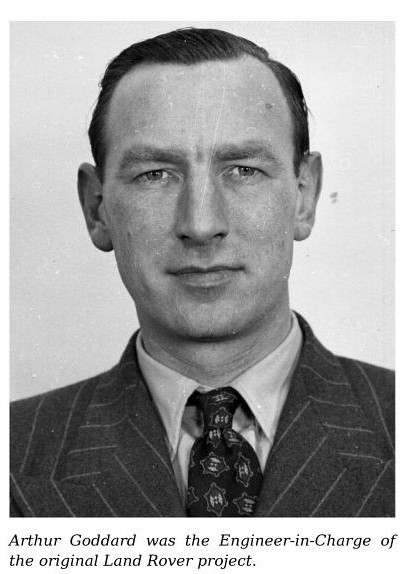
 Arthur Goddart
|
 ENGINEER RESPONSIBLE FOR FIRST LAND ROVER MAKES SURPRISE VISIT TO BRITAIN
10 May 2010
ENGINEER RESPONSIBLE FOR FIRST LAND ROVER MAKES SURPRISE VISIT TO BRITAIN
10 May 2010
|
Arthur Goddard, who led the engineering team that developed the original Land Rover, has returned to Britain to celebrate the iconic 4x4 vehicle’s 62nd birthday. The 89-year old, who is still chief engineer of his family’s Australian-based trailer firm, last week visited Land Rover’s design headquarters, Solihull factory – his first visit for 55 years –and was also guest of honour at the special 62nd birthday party at Gaydon organised over the May Day Bank Holiday weekend.
‘Solihull is unrecognisable from the factory I left in 1955,’ says Arthur. ‘Seeing the Defender coming down the production line however did bring back memories. It’s astonishing that a vehicle that was really developed as a “stop gap” should continue to be so successful, and has given birth to a thriving 4x4 company.’
Arthur joined Rover in 1945, initially to help develop a new tank engine. Once the war ended, the 24-year old was moved onto car engines. Soon after, in Easter 1947, Maurice Wilks had his brainwave for a pioneering all-terrain vehicle – the Land Rover. Arthur’s responsibility was to design and to develop the vehicle, for production. Working under him were such Land Rover legends as Tom Barton and Frank Shaw (transmission), Gordon Bashford (chassis), Joe Drinkwater (engine) and Sam Ostler (body design).
Arthur Goddard, 91, who was chief engineer of the first Land Rovers from 1947 to 1972, believes 4WDs will become victims of their size, fuel consumption and safety issues. "They would use about 25 per cent more fuel than they need what with the wheels, weight and gears, plus driving the other two wheels loses a lot of efficiency," he says. "Their chassis is too stiff and they don't absorb a crash as well as a car with crumple zones.
"Cars will be a lot smaller in the future. There really is no reason to have an engine any bigger than one litre."
Goddard believes the future for Land Rover is in the coming front-wheel-drive version of the Range Rover #aacEvoque compact SUV.
"The days of big 4WDs are numbered." Goddard was "discovered" by a Series 1 Land Rover owner working nearby in Brisbane, leading to the publication of a book last year about his engineering feats, called They Found Our Engineer, written by Michael Bishop.
He has now been welcomed into the Series Land Owners (SLOW) historical 4WD club as founding patron. Goddard never thought such a fuss would be made over him when he was working on the first model in 1947.
"Our biggest challenge was to produce a suitable vehicle for agriculture and the army," he says. "We never thought anyone would be daft enough to use a 4WD with such bad fuel economy to take the kids to school.
"My family all have 4WDs. I'm the only one with a proper car," says the proud Hyundai Excel owner who has never owned one of his own products. Goddard says the challenge for the Series 1 Land Rover was to compete with the famed American Willys Jeep and robust farm tractors.
He boasts that it was lighter and rustproof with its advanced aluminium body, had a 50 per cent stiffer box-section steel chassis, featured a four-speed gearbox rather than three and had a more efficient engine.
Series models have leaf-sprung suspension, can be started with a front hand crank and could fit farming machinery to the rear, such as thrashers, ploughs and slashers. "I knew nothing about military or agriculture, just about cars," he says. "I drove number three off the line to the Amsterdam motor show in '48 and everyone was really enthusiastic. "The British Army ordered 1000 vehicles. I shouldn't think they are selling too many to the farmers and armies nowadays."
Goddard returned to the UK last year and drove some of the new models. "They are very fine vehicles, but they are more of a car these days," he says
Arthur Goddard is a rare survivor of the management team who designed, built and developed the Land-Rover in 1947-48. He was Project Engineer, responsible for turning the original ideas into a working, reliable, financially viable vehicle for the post-War world. In doing so he helped save the Rover Company from collapse, and also helped create a legend that's lasted for over 60 years. Once the vehicle was a success, but before it became a worldwide cult, Arthur moved on to other parts of the UK motor industry, and so history tended to forget his vital contribution to 'The Best 4x4xFar'. Now living in Australia, and still working hard at the age of 89 designing components for the off-road trailer and caravan industry, Arthur was 're-discovered' through a chance remark in an internet chat between two Australian Land-Rover enthusiasts — one in Brisbane and the other in Worcestershire. Realising the wealth of knowledge that Arthur had about the earliest days of Land-Rover, The Land-Rover Register and Series One Clubs got together to sponsor a fortnight of events in May 2010, with Arthur as Guest of Honour. This included a visit to the Lode Lane factory, the Gaydon Heritage archives, and the Motor Industry Research Association (MIRA), where the punishing 'Belgian Pave' circuit that Arthur designed is still giving vehicle builders the chance to put thousands of miles of wear on their cars in a matter of days. Arthur also visited many of the sites used by Rover in the late 40s to demonstrate and photograph their new off-roader, and those early publicity photos were re-created for the visit using pre-pro R16 (260AC), and Dunsfold's Centre-steer replica. The fortnight ended with a dinner in Arthur's honour, attended by many enthusiasts who keep the very earliest vehicle on the road more than 60 years later.
Arthur Goddard When did you start working for Rover?
It was at the end of the war, when we still had directed labour. I was in my early 20s and I had been working for the Aero Engine research lab with Alvis, when a vacancy opened at Rover. I had the experience for the job, so they sent me there as assistant chief engineer. Once things had calmed down with the war and you could work where you chose, I had settled in at Rover, so I stayed.
What was the catalyst for the design?
The idea arose because of the number of second-hand Jeeps being sold around the world at the end of the war. My chief engineer had one and found it useful on his farm, and there was demand for a similar vehicle for the British army. So the idea came from him. I was brought onto the project later, and put in charge of design and manufacturing. I became the youngest engineer, by about 20 years, to be responsible for a complete vehicle.
Did you ever think the Land Rover would become the international icon it now is?
We were still manufacturing other cars, but yes, the development of the Land Rover was an effort to increase exports. We originally aimed for 200 a week, but before I left we were running over 1000 exports a week.
What’s your opinion of modern Land Rovers?
They make a whole range now, of course. They still manufacture the original one, but they also make ones for taking the kids to school in – we never thought anyone would buy a 4X4 to take kids to school in!
I visited the Land Rover factory in the UK last year and had a look at the new models. They showed me a design drawing of the original Land Rover I was responsible for, and the one from today. They laid one on top of the other, and there was very little difference – everything correlated; the steering wheel, the wheels. It had hardly changed at all, except that everything on the current model is modern, of course.
What about the new concept Defender?
I was impressed. It isn’t as crude as the vehicles I did, but we didn’t have the time or the presses they do now. We had to work with what was in the factory, which was why manufacturing and engineering worked so closely. We did, however, have a completed product within 12 months of concept – about two years faster than what they do today!
Is it true that the first Land Rover prototype was built on a WWII Jeep chassis?
No. We had two or three Jeeps that we took to pieces, but the Jeep was never designed for agricultural use. The Willys Jeep was purely a military vehicle. It had features we wanted, but it wasn’t complete.
What was the idea behind making the Land Rover body panels from aluminium rather than steel?
We used to call the Jeeps rust buckets. They rusted away until you could put your foot through the floor, so we learnt from Jeep’s mistake.
Today you work at the family business, Vehicle Components, in Brisbane. What does your work there involve?
I am responsible for the design of new products. I work about 30 hours a week, but nowadays it’s because I want to, not because I was directed to! The full story of Arthur Goddard’s role in the conception of the original Land Rover can be read in They Found Our Engineer: The Story of Arthur Goddard by Michael Bishop.